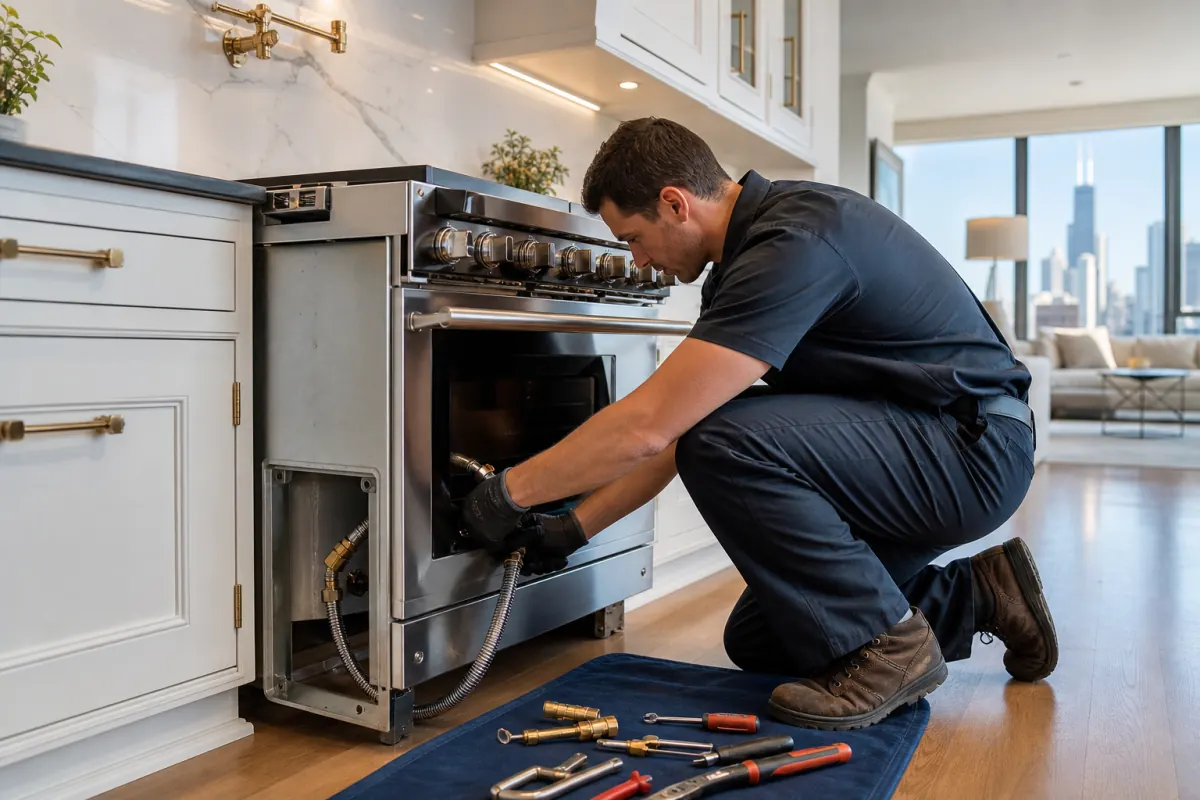
In most cases the yellow flex line behind your stove is safe, as long as it is a modern stainless connector that is undamaged and the right length. The real danger comes from old recalled brass connectors, kinked lines, and ones reused across multiple moves.
🚨 Gas Problem in Chicago? Talk to a Licensed Pro
24/7 dispatch across Chicago and the suburbs. If you smell gas right now, leave first and call 911 or your gas utility.
CSST vs. appliance connector — they look the same, but they aren't
Pull your range out a few inches and you will likely see a flexible yellow tube running from the wall valve to the back of the stove. Most people lump every yellow line together, but there are two very different products that happen to share a color.
The short, ribbed tube clamped to your stove is an appliance connector — a flexible jumper, usually three to six feet long, made to let you slide the range out for cleaning. The longer yellow tubing you sometimes see running through walls, ceilings, or crawlspaces is CSST (corrugated stainless steel tubing), a whole piping system that carries gas across the house. They are not interchangeable. An appliance connector is never supposed to run through a wall, and CSST is never supposed to be the wiggly bit behind your stove.
One more thing about CSST: because it is thin-walled metal, code in Illinois requires it to be bonded — electrically tied to your home's grounding system so a nearby lightning strike can't arc through it. If your house has CSST and you are not sure it was bonded, that is worth having a licensed pro verify.
The recalled brass connectors still in millions of homes
Here is the part that surprises homeowners. Back in the 1980s and earlier, many appliance connectors were made with an uncoated brass design. Over the years that brass could crack at the fittings and leak — which is exactly why those older connectors were recalled, and why they should never be reused. The trouble is, recalls don't go knock on doors. Millions of these are still quietly hooked up behind ranges and dryers in older Chicago bungalows and suburban homes from Oak Park to Joliet.
How do you spot one? An old uncoated brass connector often looks dull yellow-gold with no plastic coating and a thin, soft tube. Modern connectors are coated stainless steel — typically a yellow plastic jacket over a braided or corrugated stainless core, stamped with current standards. If yours looks like bare brass or you simply can't tell, don't tug on it to investigate. Have it looked at.
If you ever smell that rotten-egg odor — the mercaptan utilities add to gas so you can detect it — don't troubleshoot anything. Leave the house, and from outside call 911 or your utility (Peoples Gas in the city, Nicor in the suburbs). Private-side repairs come after everyone is safe.
How to read the date stamp on your connector
Most connectors carry markings on the brass nut or the tube itself. You are looking for a manufacturer name, a standard like ANSI Z21.24, and often a date or production code. The standard matters more than the calendar: a connector built to a current standard and in good shape is doing its job, while one with no markings at all is a red flag — it predates modern requirements or was never listed for the purpose.
Reading these in a cramped, dusty gap behind a heavy range is genuinely awkward, and the markings are easy to misread. If you can see a name and a standard and the tube is clean and uncoated brass-free, that is reassuring. If you see nothing, or anything that looks corroded, that is your cue to stop guessing. When we handle gas appliance hookups, checking and replacing the connector is part of the job, not an upsell.
The "kink test" — what damages flex connectors over time
Even a quality stainless connector can fail if it has been abused, and the most common abuser is the stove itself. Every time a range gets shoved back against the wall, the connector can get pinched, crimped, or bent into a tight U. Those sharp folds are where the metal fatigues and eventually cracks.
Here is a gentle, look-only check — never a yank-and-twist test:
- Slide the range out slowly and look at the connector's path. It should make smooth, gradual curves, not sharp 90-degree kinks.
- Watch for any spot that is flattened, crimped, or rubbed shiny where it presses against the wall or floor.
- Look for green or white crust at the fittings, which can signal corrosion.
- Notice the length. A connector stretched bar-tight or coiled into a knot is the wrong size for the spot.
If anything looks bent hard, do not try to straighten it — flexing fatigued metal back and forth is exactly how you turn a worn connector into a leaking one. A connector is a few dollars of metal protecting your whole kitchen; it is not the place to gamble.
When to swap it (and why we replace, not reuse, on every install)
The industry guidance, and our own shop rule, is simple: a flexible appliance connector is a one-time-use part. Once it has been bent to fit, disconnected, and re-bent for a new install, the fittings have already taken stress you can't see. That is why any time we move, reinstall, or replace a range, the old connector comes off and a fresh one goes on — even if the old one looks fine.
Good times to plan a swap include: when the connector is bare brass or unmarked, when you see kinks or corrosion, when you are converting an electric range to gas, or when you are capping a gas line after removing a stove for good. While we are back there, we also confirm the shutoff valve works and that there is a proper sediment trap (sometimes called a drip leg) ahead of the appliance to catch debris before it reaches the burners.
As for cost, a straightforward connector swap is usually a modest part-and-labor visit, while a full reconnection with a new valve and trap runs higher — and permit needs vary by town across Cook, DuPage, Lake, and Will counties. We pull permits and call JULIE (811) for any dig-locate work. Because every kitchen is different, we quote in ranges, never a flat number over the phone. Get a written quote — every home is different.
If you are anywhere from Naperville to Evanston to Schaumburg and want a licensed pro to look at that yellow line for peace of mind, we run mobile dispatch across Chicagoland and answer 24/7 at (708) 381-2959. Repairs start from $199, and a five-minute connector check today beats a leak behind the stove tomorrow.
Frequently Asked Questions
Are yellow flex gas connectors safe behind the stove?
A modern, coated stainless steel appliance connector that is undamaged, the correct length, and free of sharp kinks is safe behind your stove. The unsafe ones are old uncoated brass connectors that were recalled, anything bent or corroded, and connectors reused across multiple installs. If you can't tell which type you have, a licensed pro can verify it in minutes.
How do I know if my gas connector was recalled?
The recalled designs were uncoated brass connectors common before the 1990s — dull yellow-gold metal with no plastic jacket and a thin, soft tube. Modern connectors have a coated stainless core, usually a yellow plastic sleeve, and are stamped with a current standard like ANSI Z21.24. If yours looks like bare brass or has no markings at all, don't reuse it; have it replaced.
Can I reuse the flex connector when I move my stove?
No. A flexible appliance connector is a one-time-use part. Once it has been bent to fit and then disconnected, the fittings carry hidden stress, and re-bending it is a common cause of leaks. Reputable installers, including us, fit a brand-new connector on every reinstall even if the old one looks fine.
What should I do if I smell gas near my stove?
Leave the house first. Don't flip switches, light anything, or try to inspect the connector. From outside or a neighbor's, call 911 or your gas utility — Peoples Gas in Chicago, Nicor in the suburbs. Once the area is confirmed safe, a licensed company can handle the private-side repair behind your appliance.
How much does it cost to replace a gas stove connector in Chicago?
A simple connector swap is typically a modest part-and-labor visit, while a full reconnection with a new shutoff valve and sediment trap costs more, and permit requirements vary across Cook, DuPage, Lake, and Will counties. Our repairs start from $199, but pricing depends on your setup. Get a written quote — every home is different.
Do you serve my suburb for gas appliance work?
Yes. We run mobile dispatch across Chicago and its suburbs, including Naperville, Oak Park, Evanston, Schaumburg, Joliet, and the surrounding Cook, DuPage, Lake, and Will county communities. We are licensed, insured, and available 24/7 at (708) 381-2959. We serve Illinois only.
Need a licensed gas pro in Chicagoland?
Licensed, insured, 24/7. Call now or request a callback and a dispatcher will route your job.
Related Reads